This drawing illustrates a Song sparrow or Melospiza melodia climbing along a branch within a thicket of twigs and branches next a pond in my natural area. This bird was constantly moving and hopped/flew to various branches making no noise besides the movement of sticks and wings flapping. This small bird also would creep along the ground and twigs to get from one side to the other. When on the ground level amongst the leaf litter, it would pick up objects such as small twigs or leaves. It would then bring these objects to an under covered shelter area. This sheltered area was only about half a foot off the ground and had a dense thicket of branches engulfing it. This bird didn't seem to be hunting for food since it remained in the same area for an extended amount of time. Also, this small sparrow was completely alone at the time and was not communicating with any vocalizations with other birds nearby. It finally flew away over the pond when it noticed my presence.
Sunday, November 16, 2014
Journal #8: Indentifying Birds
During my time at my natural area I noticed that not much has changed with the emergence of cold temperatures and dry air. There are almost no strong fungal formations that are easily seen while waking through the forested area. All the mushrooms I have seen are either dying or damaged in some way from another source. With the decline of fungi, the moss in my area seems to be thriving and there are almost no changes in its growth. It's lust green color is still present and has even spread farther out to some decomposing logs in the area. On top of all this moss is the leaf litter of broadleaf trees such as bigleaf maple and red alder. The Devil's club in the area is pretty much completely gone as well as the skunk cabbage. With the weather being quite dry and very cod in the past week, the moisture in the forest has dropped drastically and some previous swamp-like characteristics are now nonexistent. There are no areas with deep mud and wet puddles and all that remains now are hardened icy dirt and soggy patches of land. Also, many ferns have started to die off and the population of ferns have declined and thinned out. This cold be due to the cold temperatures and the start of winter coming soon. Even though the temperature has begun to drop, the chipmunk community is still highly active in search of food to store for the upcoming winter months. Many could be seen scrambling around the forest trail hunting for seeds and nuts scattered around the ground layer of conifer litter. Along with these chipmunks, birds such as song sparrows, american robin, and black-capped chickadees are communicating and vocalizing in various trees.
This drawing illustrates a Song sparrow or Melospiza melodia climbing along a branch within a thicket of twigs and branches next a pond in my natural area. This bird was constantly moving and hopped/flew to various branches making no noise besides the movement of sticks and wings flapping. This small bird also would creep along the ground and twigs to get from one side to the other. When on the ground level amongst the leaf litter, it would pick up objects such as small twigs or leaves. It would then bring these objects to an under covered shelter area. This sheltered area was only about half a foot off the ground and had a dense thicket of branches engulfing it. This bird didn't seem to be hunting for food since it remained in the same area for an extended amount of time. Also, this small sparrow was completely alone at the time and was not communicating with any vocalizations with other birds nearby. It finally flew away over the pond when it noticed my presence.
While walking through the watershed preserve, I heard a constant hammering noise against some hollow object. I instantly knew it was a pileated woodpecker (Dryocopus pileatus) from its obvious pecking sound that it emitted across the forest as well as my previous sightings of this woodpecker before. This bird was on a dead tree that was about twenty feet high and only had a few thick branches and exposed areas with bare wood. It was not communicating with any other birds and only produced a loud pecking sound against this hollowed out decomposing tree. There were no bird around or even on the same tree as this bird and I have never seen multiple pileated woodpeckers in one area making it seem as though they are solitary creatures. I observed this bird for about thirty minutes until it flew away in the other direction. It stayed on this tree for a while and would hop up and down using its talons to grip the bark in order to hold on. The pecking was not constant either and the bird would take breaks and then continue to peck at the wood of the tree.
This drawing illustrates a Song sparrow or Melospiza melodia climbing along a branch within a thicket of twigs and branches next a pond in my natural area. This bird was constantly moving and hopped/flew to various branches making no noise besides the movement of sticks and wings flapping. This small bird also would creep along the ground and twigs to get from one side to the other. When on the ground level amongst the leaf litter, it would pick up objects such as small twigs or leaves. It would then bring these objects to an under covered shelter area. This sheltered area was only about half a foot off the ground and had a dense thicket of branches engulfing it. This bird didn't seem to be hunting for food since it remained in the same area for an extended amount of time. Also, this small sparrow was completely alone at the time and was not communicating with any vocalizations with other birds nearby. It finally flew away over the pond when it noticed my presence.
Sunday, November 9, 2014
Journal Entry #7: Fungi Drawings
During my time at my natural spot
the weather was great and there was absolutely no rain and clear skies. But
with these clear skies, it brought very low temperatures and dry cold air
within the forest. While I walked through the conifer forest in the early
afternoon, birds were singing everywhere and robins could be seen flying from
branch to branch. As I stepped over fallen logs and decomposing plants to reach
my specific observation area, I noticed many new species of small fungi have
emerged from decomposing logs and wood scraps from recent windstorms. There
were still spots that were covered with yellow bigleaf maple leaves but many of
them have started to rip apart and die off for good. As I sat down and looked
at my surroundings, I noticed that many logs have lost there bark and have
exposed rotting wood sections. This might be due to some animal activity or
just weakening in the wood that caused it to fall off as it decomposed. The
moss of the forest floor was still prominent and showed no signs of dying or
weakened growth. The Devil’s club in the area was almost completely gone and
the Skunk cabbage has begun to die off as well. Brown holes have appeared in
the large wide leaves of the skunk cabbage as it droops downwards. It seems
that most of the skunk cabbage that’s dying is in the wettest areas. This could
be due to fungal infections of just temperature changes that are causing the
death of the skunk cabbage. I walked over to the pond in my area after I took
notes and wrote down my observations of my natural area. Once I got there I saw
a male and female Mallard duck. I recognized the distinctive green head of the
male and the brown feathers of the female. It is important to distinguish the
mallard from the merganser because they have similar colored heads in the males
yet the beak of the merganser is curved down towards the tip. The chipmunk
activity wasn’t too high during my time there most like due to the large amount
of people in the reserve.
One of the most prominent mushrooms
in this area would be the Shrimp Mushrooms or Russula xerampelina. This fungus has a reddish pink cap with a darker
disc or center in the middle. The color of the cap becomes lighter as it nears
the margin or edge. The cap is slightly sticky and slick especially after a recent
raining. The gills of this mushroom attach to its creamy white stem and annulus
that usually yellows with age. These mushrooms usually emerge in decomposing
conifer litter in lowland mountain ranges. It tends it enjoy warmer weather but
continues to grow into the cold months of fall.
Another fungus that is emerging in
numerous places within the Redmond Watershed Preserve is Goat’s beard or Hericium
abietis. This fungus is a whitish grey that
has hundreds of filaments clusters of spines that have pointed tips. The spines
begin to turn reddish orange with age. This mushrooms usually grows at the foot
of large conifer trees and thrive in conifer needle litter. Also, this fungus
can coexist with other smaller fungi and is usually surrounded by decomposing wood
and logs as well. This fungus grows in lowland mountain ranges in the fall and
winter months when it’s cold and rainy.
The other fungus that I noticed in
extremely wet areas was the turkey tail or Trametes veriscolor. This mushrooms is very distinctive due its
multicolored bands and white underside. The bands tend to become darker and
darker as it goes up towards the sun. The surface is slick and somewhat shiny
with bumps and rough in some areas. Also, this fungus uses dead and decomposing
nurse logs as support and as a place to grow. The surrounding habitat is
usually very wet and this specific fungus was found on a log in the pond. This
fungus also grows year round and can endure many different temperatures and
weather.
Another interesting fungus that I
noticed emerging in my area was Witch’s butter or Tremella mesentercia. This fungus is very easy to spot in this dark and
brown forest since it has a specific bright orange color and gelatinous
structure. This fungus has numerous lobes and blobs that form and large mass
that attaches to decomposing logs. This mushrooms grows in lowland mountain
ranges in either the fall or spring and it enjoys large amounts of rain yet
somewhat temperature weather. The surrounding habitat of this fungus is usually
conifer liter and dead trees and logs.
One of the largest mushrooms in my
natural area would be the short-stalked white russula or Russula brevipes. Its large gills angled upwards can characterize this
fungus and it’s smooth white top that is curved and warped. The stem is also
very large and has a slight annulus that connects to the stem and then ends at
the volva in the decomposing dirt. This mushroom usually grows in conifer leaf
litter and in wet dirt underneath large conifer trees. Also, the surrounding
area is usually next to trails and disrupted natural areas.
Another fungus that uses nurse logs
as support in my area is Angel wings or Pleurocybella porrigens. This fungus is usually always found on decomposing
logs that have either fallen or rotting inside. It tends to grow along with
mosses and on damp decomposing wood. This mushroom has a smooth white cap that
emerges from the woods bark. There are separated white gills underneath each
cap. This fungus usually grows in lowland mountain ranges and tends to grow in
extremely damp and wet places.
Sunday, November 2, 2014
Journal #6: Nature Experience
During my time at the Redmond Watershed Preserve, it was pouring
profusely and the trail to my site was basically a stream. I walked into my
area and noticed that the ground was covered in Bigleaf maple (Acer macrophyllum)
leaves. Everything was absolutely soaked as large drips from the various trees
fell to the ground. Some shrubs such as Devil’s club were still vanishing and
new fungus were emerging from the decomposing conifer floor. Since there weren’t
many broad leaf trees in my specific natural area, the leaf litter was minuscule
but the moss was rampant. Along with this moss grew different types of mushrooms
such as Shrimp mushrooms and Goat’s beard. In the past there have been other
types of fungi but with the increased rain and cold weather new colonies have
emerged out of either nurse logs soaked in water or decomposing leaf litter.
There wasn't much bird activity as well as chipmunk activity in this usually
lively forest. The rain was so constant and hard that the birds were probably
sheltered due to the lack of prey present in the area. There is no point for
these creatures to hunt and search for food which ultimately costs them energy.
I walked farther in to the preserve towards the pond in search of some
wildlife. While the rain rippled the pond’s surface, I thought I saw some
mallard ducks across the water but it was too far to see.
The plant that I thought looked unique in this environment
was the Sword fern. With its long central rod with emerging curled swords at
the tip. These flat swords began growing larger as they lined the sides of the
central rod down to the decomposing forest floor. On the back of each of these
swords there are two rows of buttons of pollen that smear when rubbed in your
fingers. This was not the only rod of the plant as a whole though. There were
multiple bright green rods in a cluster emerging in different directions and
hanging at a slight arc while water weighs it down.
Since it was pouring down rain while at was at my natural
area, there were not many birds out looking for food or even singing songs. The
only bird that I was able to see was a couple of robins in a distant tree. They
had smooth brown backs that stretched down to a grouping of soft pads that
spanned into a larger width than the body. The bird’s nose was small and was
about half the size of its head. The chest was white and seemed to have some
spots ruffled into the soft frontal area. The feet of this creature was the
hardest feature to see but it almost seemed like it was cover by the soft white
underbelly.
The last organism I observed was the Sow bug when I lifted a
semi-buried rock to reveal dry dirt. As I looked upon this insect that was
scrambling to find darkness, it had a round oval shell like body. This hard
shelled body had different sections and plates which resembled metal armor. At
one end of this shelled oval, there were two lines bent with a 90 degree angle
in the middle. Little spikes were emerging from the two long sides of this
plated shell armor that quickly sped away. Usually I used to seeing these bugs rolling
into a ball as a defense method yet this organism lacked his ability. On the
edge of the oval there was a flat bend in the multiple plates that was
horizontal with the ground. This physical trait keeps the creature from rolling
into a ball.
Saturday, October 25, 2014
Journal Entry #5: Redmond Watershed Fungi
As I made my way into Redmond I noticed very ominous dark skies and knew it was going to rain hard. Since it was going to rain that meant the fungi in my natural area would be fresh and prominent within the wet decomposing forest. When I arrived to my spot it was pouring down rain and I was forced to wear my rain suit from boy scouts. I marched through the mud and rain trying to take photos without soaking my phone and only took notes within my rain jacket. I sat at the base of a larger western red cedar to make my observations. I heard numerous bird calls even though it was hard to hear with the falling rain against the wood and ground. Even though I did not see any of these birds since they were tucked away in the leaf cover, there were many other creatures roaming about. There were hundreds of frogs that could be heard from the pond near my area. I walked close to the water and saw a Pacific tree frog underneath a sword fern. He jumped away into the water before I had a chance to get a photo but I recognized its darker green body color with strips on the its back. Back at my natural site, the Devil's club population was completely gone and all that remains are the spiked branches erecting from the decomposing conifer litter. Many ferns are still looking healthy and moss covers the entire patch of ground my site is located. A key phenological change I noticed though was the emergence of different fungi since I was last there. As I walked through my spot searching for mushrooms I noticed many areas that were once dominated by White matsutakes have been overrun by Shrimp mushrooms and Goats beard. This could be due to changes in leaf litter and the ability they have to decompose specific leaves. Also, the temperature is starting to drop drastically and new fungi that emerge are possibly more tolerate to colder temperatures than other fungus that were emerging earlier in the season.
This was the first mushrooms I stumbled upon during my trip into the watershed. This is a Shrimp mushroom or Russula xerampelina and it can be characterized by it's bright pink cap with a darker red ring in the center. Also, this specific mushroom can tend to have an almost fishy smell to it which allows it to be easily identified. This fungi was found on the dead conifer and dirt litter near a decomposing tree. The bordering habitat was composed of sword ferns and and water soaked wood that have fallen off of trees. The weather was extremely wet and rainy and this gave the mushrooms and shiny tint to their caps.
This strange mushroom is called Goat's beard or Hericium abietis and can be characterized easily by it's strange physical structure. This fungal formation is different from the usual cap and stem and this allows it to stand out and be distinctive to the wondering eye. Goat's beard is a darkened white in it's early stages of growing but as it ages it retains an almost orange/brown color. When I discovered this fungi, it was at the base of a living tree and seemed to be connected to it's main root. It was surrounded by dead conifer needles and various sticks and twigs. Also, this mushrooms was in a highly dense moss area which might contribute to it's growing ability. The weather outside was very rainy and had been hours before I arrived.
This odd fungal colony on the side of this tree are Angel wings or Pleurocybella porrigens. Charaxterizing this fungus is easy due to its distinctive structure and location of growth. This fungus was found on the side of a nurse log that was covered in various mosses and lichens. These white formations are very smooth on the top and curve downwards but have noticeable gills. The surrounding area was full of moss and ferns with extremely wet and moist ground directly below. Water had collected in some areas on top of the emerging fungi from the rainy weather.
At a distance I first though this was a piece of trash someone had left behind but I soon realized it was a fungus. This thick and hard fungal formation is called Varnished conk or Ganoderma tsugae. This fungus can be characterized by it's fan-like shape and dark orange color on the top of it's structure and a dirty white middle section that collects water droplets. This mushrooms was found emerging out of a wet decomposing log with moss all over mush like the tree that harbored the angel wings. The surrounding area was dead conifer needles and wet patches that have started to form puddles. The weather was still very rainy when I stumbled upon this species.
This fungus is very prominent in the watershed I visit each time yet it is very different from many other species of mushrooms in this area. This mushroom is a type of Chanterelle due to its cap formation and it's distinctive gill structure that is angled upwards.The top of this mushrooms was covered in the dirt that was above it when it emerged out of the soggy ground. This fungus was found on the side of the trail in a thick layer of decomposing conifer needles and dirt with a thin layer of moss on the surface. the surrounding area was dominated by moss and a scattering of twigs and needles but was covered by the canopy of trees above which prevents a lot of water falling directly on the fungus. the weather was very rainy but this mushrooms seemed to be quite dry.
This colorful fungus is called Turkey tail or Trametes veriscolor and can be characterized by it's layers of changing colors and it's resemblance to the tail feathers of a turkey. I has a wet and slimy coat over it and is quite stiff with touched. This fungus was found emerging off of a tree that had half submerged in pond water and the other half suspended in the air at a horizontal angle. The surrounding area was extremely wet since it was right next to a pond and it had been raining earlier. Also, it coexisted with moss on this old and damp log and shared it with no other noticeable fungi. The weather was still very rainy and it had been rainy for a long time while I was in my natural area.
Saturday, October 18, 2014
Journal Entry #4: Invertebrates
My third visit to my natural area in Redmond, there were many significant changes that have occurred during my two week absence. While I was at Mount Rainier for my natural history field trip, Bigleaf maple leafs began to turn a bright yellow and fall to cover a majority of the forest floor. When I arrived to my area, only decomposing needles and moss covered the ground. Since there are many Bigleaf maples in other areas of the reserve, my area was free from decomposing broad leaves. Many plants are at the early stages of dying off before the winter such as the Devil's club. As I observed my site carefully I noticed that there was no longer any recognizable Devil's club leaves. Only their spiny and sharp branches emerged from the ground but have started to slightly lean over. Along with the Devil's club, many fungi that have seen in this area have completely disappeared, yet some new fungi have emerged but in different locations. Shrimp mushrooms have started to grow near decomposing logs and wood that have high amounts of moss on them. Along with the shrimp mushrooms, Witches butter has also emerged on dying logs but this type of fungi could only be seen near the developed paved path in the reserve. It's odd bright orange gelatinous shape easily catches the eye of either people or animals walking by. Another bright orange fungus that began to grow on old trees was the Orange peel fungus. Characterized by it's cup-like shape and distinctive orange color also makes it easy to see in this dark green and brown natural area. Although the fungi was plentiful, the skunk cabbage was also in full force. Since this area is a wetland, the moisture concentration is very high and allows this plant to grow large leaves to catch sunlight. While sitting at my natural area I could hear the constant hammering of a woodpecker at work. From my previous experience seeing woodpeckers in this area, my best guess for the species would be a pileated woodpecker. I continued to walk through the reserve towards the water to gaze upon the stillness it brings. Small chipmunks would make squeaking noises as I walk through the dense forest. But I spent the majority of my time in this area observing numerous insects in my natural area.
This invertebrate is common called a Blue Darner or Aeshna multicolor. It is characterized by it's distinctive blue spots that run along the top of its segmented abdomen. Also this species of dragonfly has two fore wings and two hind wings which give it more control and maneuverability while in flight. This insect is covered by a hard black exoskeleton with a few blue spots. Also, it has three pairs of legs and uses these to land on plants and other objects. While observing this organism I noticed that it tends to land on vertical blades on thick grass. As I watched it fly across the water in the still pond, it would move quickly to various logs where it would land for about three to five seconds and then move on to the next area.
This cute little fuzzy insect is called the Banded Woollybear Caterpillar or Pyrrharctia isabella. This caterpillar is not very hard to distinguish and many people have seen these in the wild before. It is characterized by it's two black bands on each end of it;s body with an red/orange band directly in the middle. This caterpillar is engulfed with small bristles which give it some defense against predators and some species in it's family produce histamines that can be transferred when the bristles are touched by a foreign object. Also, I gently touched it with a twig and it quickly formed into a curl and stayed in that position until it believed the threat was gone. Also, a completely black head can be seen at one end of the caterpillar yet all of its legs are covered by bristles.
This invertebrate is called the Ground Beetle or Pterostichus lama. This beetle is very common in decomposing coniferous forests under rotting or fallen logs. It can be characterized by it's ridged abdominal exoskeleton structure as well as it's constricted thorax and abdomen junction. This beetle is usually nocturnal so I have to lift up a few pieces of decomposing wood in order to see and observe this organism. I would flee immediately when exposed to sunlight and I tried to cover it with a leaf to test whether the darkness meant some safety for them. When I placed a leaf on top of the fleeing beetle, it completely stopped moving and would not emerge from under the leaf until it thought the threat was gone. Also, when exposed to sunlight this beetle would scramble towards any wood and covered areas.
The insect shown in this sketch is the Black Carpenter Ant or Camponotus pennsylvanicus. This ant is very common in decaying forests and moist environments. This ant can be characterized by it's large head, hairy thorax, and slightly brown legs. The behavior of this ant was very strange and complex. this species of ant is usually found in large swarms and there were only a few I found in my area. I dug through some decaying bark and wood piled on the ground and found some to observe. They usually scatter when exposed to daylight light and taken from their decomposing warehouse of wood. Their abdomen is plated which allows more maneuverability for the exoskelton which tend to be stiff and hard.
Finally the last invertebrate I decided to sketch was the Sow bug or Oniscus asellus. When observing this organism, I thought it would be able to roll into a ball as a defense mechanism but I was surprised to notices that the edges of it's exoskeleton were horizontal and flat. This structure prevents the sow bug from rolling into a ball and therefore much look to shelter for protection. This insect is characterized by it's overlapping shelled exoskeleton as well as it;s two large antennae that it uses to detect objects. Also, this bug has seven pairs of legs making it distinctive from other insects. When exposed to light, the Sow bug would retreat to dark moist areas and would try to remain covered no matter what.
Some other invertebrates I encountered on my trip to my natural area were Waterstriders (Aquarius remigis), Brown marmorated stink bugs (Halyomorpha halys), and a Yellow-spotted millipede (Harpaphe haydeniana)
Wednesday, October 15, 2014
Journal #3: Mt. Rainier Field Trip
The first plant I identified at The Nisqually Refuge was the
Common Snowberry or Symphoricarpos albus.
This plant is characterized by its distinctive white berries it produces as
well as its pinkish bell-shaped flowers in the spring. This shrub tends to prefer
shady and moist conditions such as wetlands or floodplains. Also, this plant
produces a think system of roots and is actually usually for erosion control
due to its ability to stabilize surrounding soil. It has adapted to grow this
thicket of roots in order to be able to survive in moist and loose soil
environments. Also, this plant has evolved to produce berries that are edible
to animals so when these animals expel their waste it spreads its seeds to
different areas.
The Bigleaf maple (Acer
macrophyllum) was also present at the Nisqually Refuge. Characterized by
its large leafs with five lobes, the Bigleaf maple retains these huge leaves in
order to catch large amounts of sunlight yet lose a lot of water in the
process. This tree tends to be near riverbanks and high moisture soils due to
their water lose during photosynthesis. Also, these trees tend to live in windy
areas, which has driven them to evolved winged protection for their seeds. This
adaption in seed structure allows the wind to carry it greater distances and it
allows the seed to fall slowly and safely to the ground much like a helicopter.
These trees were spotted at Mima Mounds and are actually two
different species. Directly in the middle is a Red alder (Alnus rubra), which is characterized by its ability to produce both
female and male catkins. Also, the red alder has adapted to be a pioneer
species in that it can grow on extremely poor soils and surfaces due to its
ability to fix nitrogen from the air. The
two trees on each side of the red alder are Oregon Oak trees (Quercus garryana) and tend to dominant
these prairie lands. Like many trees, Oregon oak protects its seeds with a hard
shell and they are eaten by birds and small mammals which then spreads the
seeds across the landscape. This adaptive relationship allows this tree to
spread rapidly and in areas where other trees typically don’t grow thus making
it easier for the oak to gain sunlight and deal with less competition.
While I trekked up Mt. Rainier I noticed this tree which is a
Mountain hemlock (Tsuga mertensiana)
which was much scarcer than the dominant subalpine fir. This tree is
characterized by its smaller needles and its conical crown and drooping leader.
This adapted shape allows it to survive in snowy environments because the
conical shape and drooping tip sheds snow off easily. An adaptation that allows
this tree to grow in such extremely cool temperatures and poor soil conditions
is its ability to have a thick and strong root system gives it support during
the permafrost winters. Also, this tree is highly shade tolerant which allows
it to survive the long foggy falls and winters on Mt. Rainier.
This low-land shrub is called Red-mountain heather (Phyllodoce empetriformis) and it grows
all over the upper alpine range of Mt. Rainer. This plant is characterized by
its short blue/green needles and its pink bell-shaped flowers in the spring. Also,
this plant usually thrives in high elevations zones and moist environments.
This shrub has adapted to combat high winds and cold temperatures by growing
short and having a slow growth process in order to remain under the snowpack
during the winter. By doing this, they are protected by the snow from open
surface temperatures that could freeze the plant and the high winds are unable
to harm the shrub.
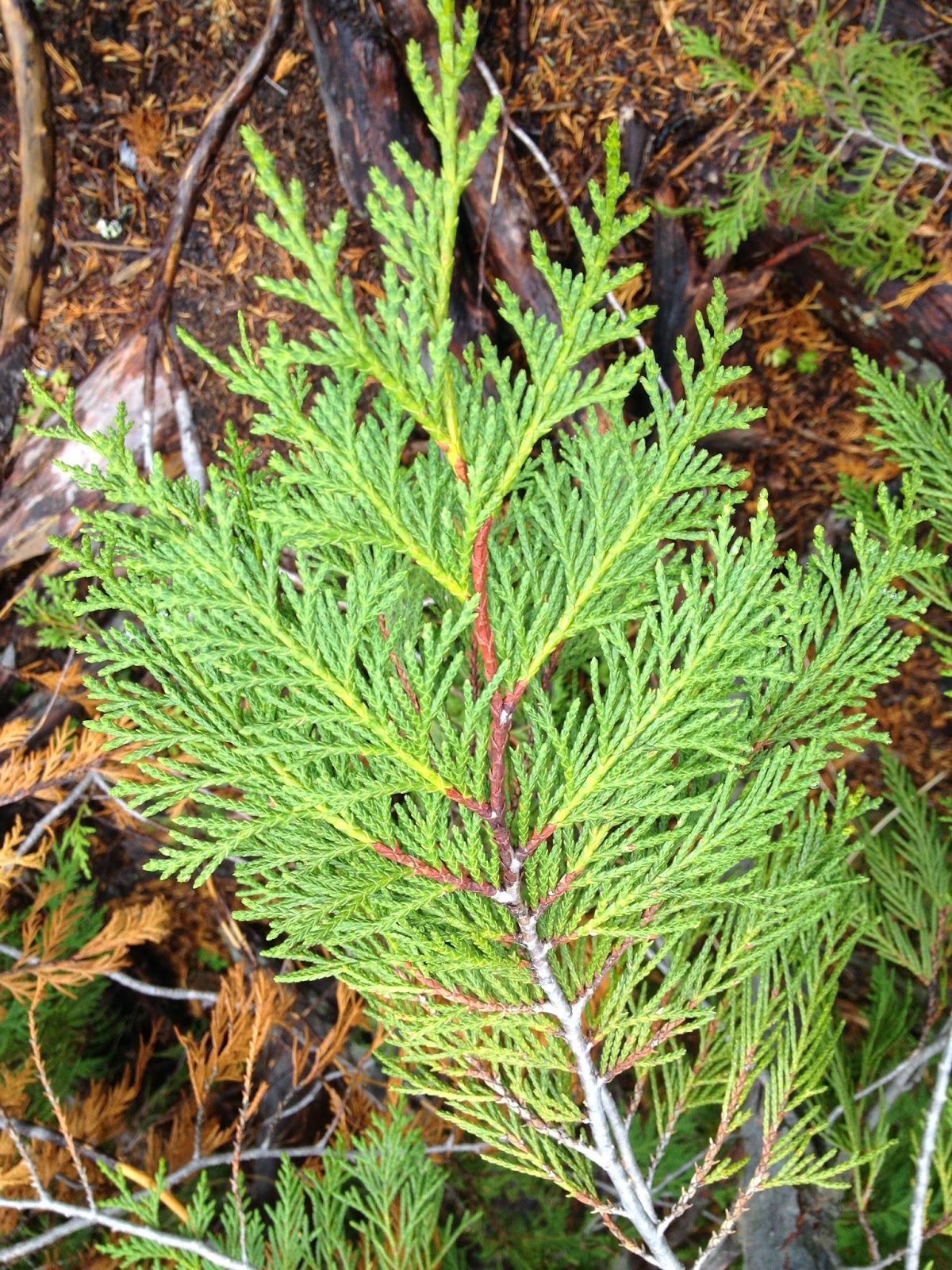
Another tree that I spotted on Mt. Rainier was the Alaska
yellow-cedar (Chamaecyparis nootkatensis)
and it looks much similar to the western red cedar but some key differences.
This tree can be characterized by its yellow/green scale-like leaves and its
droopy type shape. This drooping shape allows for snow to easily fall off and
keeps the tree from being weighed down by the snow. Also, this tree is
extremely hardy and usually only needs conditions that have a lot of sun and
moist soil making it well adapted to cold temperatures and high elevations.
This shrub called Devil’s club (Oplopanax horridus) was
spotted in the old growth forests of Mt. Rainer. This shrub typically likes
well-drained moist soils and can be characterized by it’s large spines on its
stem and leaf bottoms. Also, this shrub produces a large amount of red berries
that bears are quite fond of. This adaptation of producing berries allows it to
spread it’s seeds through the waste of bears. Also, this plant has adapted to
form hundreds of sharp spines that prevents animals from chewing on its
branches and large leaves.
This thumbnail sketch shows the receding tides of the
Nisqually Refuge. This area is unique in many ways but it is an estuary which
means it is an area where salt water from the Puget Sound meets the fresh water
from the Nisqually River. This mixture
of different waters presents nutrient rich environments where numerous
different species thrive and live their lives. The Nisqually River flows from
the Nisqually glacier on Mt. Rainer which is the source of all of its water.
This glacial runoff ran down the mountain towards the southern tip of the Puget
Sound where it finally met the salt water of the sound thus creating the
Nisqually estuary.
This thumbnail sketch illustrates where the Nisqually
glacier ends and where the start of the Nisqually River begins. The glacier is
currently in retreat but about 14,000 years ago during the Ice Age, this
glacier was much more massive and carved out the bowl-like canyon in the
thumbnail. As present day neared, temperature began to rise and the glacier
started to retreat and began to melt. This melting then formed the Nisqually River,
which starts in this area in the thumbnail. The glacier caused the tree line to
rise and to stop at where the glacier reached and carved out of the granite and
other mineral.
Today many glaciers in the world are retreated and nearly
diminished, yet the Nisqually glacier is still present but won’t be within the
next century. Mount Rainer has been shaped and carved by glaciers throughout thousands
of years. During the Pleistocene era, the Cascade Range was overwhelmed by
massive glaciers and at this time ice volumes were at an all-time high. Valleys
and Canyons were filled to the brim with solid ice and this glacier extended 60
miles down the mountain reaching the lower land regions surrounding the
mountain. Since the little Ice Age starting from 1250 to the mid 1800’s, the
glaciers on Mount Rainer have been receding due to higher temperatures. Currently
the buildup of snow and ice is much slower than the melting rate thus causing
the glacier to retreat up the mountain even when the glacier is moving down the
mountain about seven inches a day.
Saturday, October 4, 2014
Journal Entry #2: Redmond Watershed Preserve
It is slightly darker outside at my natural area but retained
a cool breeze for the duration I was there. While walking through the forested
watershed I noticed there were more species of emerging fungi from numerous
decomposing logs that were there last week when I visited. The one fungi colony
that fascinated me the most was Goat’s Beard, a white fungus with many spine
clusters in a dense grouping. The tips were completely white indicating that is
was a new emerging fungus since their spine tips usually gain a reddish tint
with age. Along with the Goat’s beard, a small orange capped mushrooms emerged
alongside the spine like fungus. As my observations continued I noticed that
the Devil’s Club in my area seemed to be withering away since the leaves were
much more yellow and wilting. Also, there seemed to be less individual plants
so either they were tampered with or died off over the course of the week. The
strange white fuzz or mold also seemed to be disappearing quickly mainly due to
the lack of decomposing fungi in the area but I’m sure it is still prominent in
other areas of the watershed. The male and common sword ferns are still
dominant on the ground level as well as the moss that engulfs a majority of the
ground. As I was sitting on a log in the watershed a chipmunk was making a chirp-like
noise at a constant rate over my head. Maybe it was signaling others of my
presence or trying to express its dominance and territorial boundaries. While I
was there, it seems that there was more tree frog and chipmunk chatter compared
to last week’s symphony of bird calls. This might be due to the time of day or
the presence of numerous chipmunks in my area. Most of the King Boletes and
White Matsutakes were smashed and decomposing. I flipped over a squished king bolete
and about ten small narrow black insects scrambled from the stem and retreated.
As I continued to walk through the forest I noticed a distant “hooting” that
only occurred about every two minutes. From my past experience of seeing owls I
assumed that it was a Spotted Owl. Although I couldn’t see it, I have seen many
Spotted Owls in this area and this species of owl is one of few that call
during the daylight.
Subscribe to:
Posts (Atom)
_copy.jpg)
.jpeg)
.jpeg)

.jpeg)